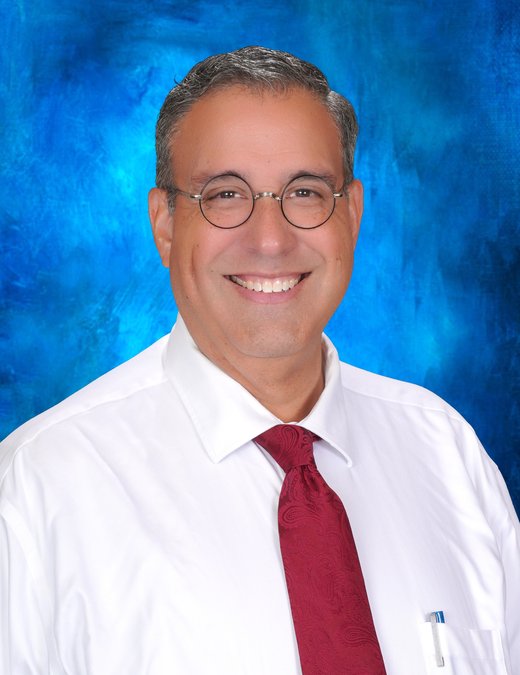
By DR. GEORGE MEGENNEY
Principal, Collegeville and Farmington
It has often and recently been said that students across the country and the state are learning “new math” that is different from the “old math” we, of a certain age, were taught some time ago. While it is true that math is being taught in different ways today, the math itself isn’t so different. Ultimately, the purpose of tackling math instruction a little differently than it was done decades ago is to develop our students’ thinking and problem-solving skills.
Within Escalon Unified, and facilitated in partnership with math instructional experts from the San Joaquin County Office of Education, elementary teachers across the district have been participating in professional development designed to enhance their mathematics instruction and strategies. At the center of the training is a book by Dr. Peter Liljedahl, a professor of mathematics at Simon Frazer University in Vancouver, Canada, titled Building Thinking Classrooms. In this book, Dr. Liljedahl discusses his research on the topic of math instruction and proposes a number of recommendations about how individual teachers, schools, and school districts can work toward improving students’ understanding of mathematical concepts.
Key among the recommendations made in Building Thinking Classrooms is beginning math tasks with high-engagement, low-routine tasks that help students to begin thinking and to share their ideas, randomly assigning students into small groups in which they work together to examine a math-related question, and the use of non-permanent vertical writing surfaces similar to whiteboards on which to write out their thoughts. So what does all this mean, and what does it look like in a classroom? I recently had the opportunity to join second-grade teachers from across our district at a math training and observed a second-grade math lesson from start to finish. What I saw was genuinely outstanding.
The lesson began with the guest teacher, Mrs. Kelly Russell, a Math Coordinator from the San Joaquin County Office of Education, inviting students to sit on the classroom carpet. She asked the gathered students to think about money and what they knew about it. Hands immediately shot up in the air. One student described different coins, another student talked about money being made of paper, and another student talked about the different numbers associated with money, explaining that there were pennies worth one cent and nickels worth 5 cents. All descriptions were welcomed and written down, validating students’ contributions.
Beginning a lesson this way helps open up student thought to a topic in a way in which there aren’t any right or wrong answers, just observations and ideas. As students engage with a topic, drawing their attention to and weaving in the learning objective becomes a natural part of the process. In the sample lesson, the objective was to teach students about the different values of coins. Mrs. Russell had large pictures of different coins to point to and made sure that the respective numbers and values associated with those coins were clearly labeled for students to see while the discussion was taking place.
Around the classroom, non-permanent whiteboard-type writing surfaces had already been set up. Students were randomly assigned in small groups to different spots in the classroom and given a problem to think about. One student was assigned the task of writing on the board while the others helped to provide the explanations that were turned into written thoughts on the boards. Some students drew pictures to represent their ideas, and others wrote down numbers. Every small group participated and demonstrated that they were thinking about the topic. As students talked and wrote down their ideas, Mrs. Russell walked around the classroom, interacting with each group, and asked students to explain their thinking and praised them for sharing their ideas. After a few minutes, students were called back to the carpet and once again asked to share their ideas. Again, multiple hands went up in the air.
The lesson continued with more students sharing what they wrote and how they were thinking about the coins. Mrs. Russell used student examples to highlight differences in values and counting those values to reach a specific amount. Again, not right or wrong, just different. You can get to thirty cents with three dimes or six nickels after all. Another thinking task was assigned, and students returned to the non-permanent whiteboards, this time with plastic coins to help further facilitate their thinking. Student engagement continued to be high, and students appeared to be enjoying the activity. The lesson ended with another gathering of the students, more sharing of observations and ideas, and wrapped up with a brief written assignment for students to complete, which is designed to serve as student data regarding their individual understanding of the learning objective.
The structure of the lesson and implementation of the teaching strategies from Dr. Liljedahl’s book, Building Thinking Classrooms, are designed to cultivate students’ thinking and overall problem-solving skills rather than to ask them to memorize an algorithm without developing a deeper understanding of numbers and how they relate to and interact with one another. As I watched all this happen with a group of second graders, I thought to myself that I wish I had been taught math like this when I was a young student. Looking toward the future, if the eagerness and interest that the sample of students I observed is any indication, they will continue to develop their thinking skills in positive and useful ways.
Principally Speaking is a monthly article, contributed by principals from Escalon Unified School District sites, throughout the school year. It is designed to update the community on school events and activities.