By JIM BRUGGER And FRED YERZY
Open Sky Outreach
Planet Parade:
Saturn becomes an evening planet in September. You can watch it rise in the east earlier each night, starting about an hour after sunset at the beginning of the month.
Mars can be found in the eastern sky between 2 a.m. and sunrise all month.
Jupiter has emerged from behind the sun and joins Mars just before sunrise in the predawn sky.
Uranus can be seen with binoculars or a small telescope in the early morning hours about seven degrees below the Pleiades star cluster.
Constellations and Celestial Highlights:
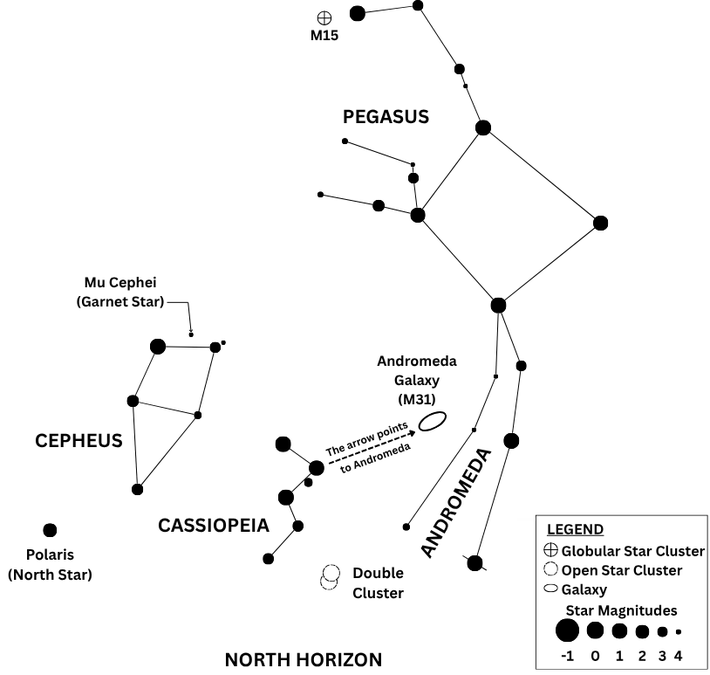
Andromeda, Cassiopeia and Cepheus: A tale of beauty, vanity and pride from ancient Greek mythology that would rival the Kardashians. In the legend, Cephus and Cassiopeia, the King and Queen of Aethiopia, had a daughter, Andromeda. Cassiopeia, generally portrayed as one of great beauty and vanity, openly bragged that she and/or her daughter were more beautiful than any of the Nereids (Sea Nymphs), the daughters of the sea god Nereus. That boastfulness angered the gods, specifically Poseidon, who unleashed his wrath upon Aethiopia in the form of storms, floods and the sea monster, Cetus. Attempting to appease Poseidon and save their land, Cepheus and Cassiopeia tied Andromeda to a rock on the shore as a sacrifice. Just in the nick of time, Perseus swooped in, killed Cetus and rescued Andromeda. However, Poseidon decided Cassiopeia should not go unpunished and placed her in the sky, tied to her throne, which spends half the year upside down as it revolves around the north star. A perpetual reminder of the consequences of hubris and vanity.
Cassiopeia is a distinct, easily visible “W” shape in the northern sky. Three of the prominent stars form an arrow pointing south, which will lead you to the Andromeda Galaxy (M31). The Galaxy is a barred spiral galaxy, like our own Milky Way, but twice the size and can be seen with the naked eye from dark sites. At 2.5 million light years, it is the closest spiral galaxy to us in the local group of galaxies and will likely collide with the Milky Way in roughly 4.5 billion years.
Cepheus is above Cassiopeia and looks like an upside-down stick house. Of note is the “Garnet Star” (Mu Cephei) a red supergiant star, about midway between the two stars that form the base of the house. Although it may seem visually underwhelming, just remember this: It is approximately 5,000 light years away and 100,000 times as luminous as our sun. It is one of the largest stars in the galaxy and, if placed where our sun is, would engulf all the inner planets and Jupiter.
Did you know?
September’s full moon is called the Harvest, or Corn, Moon and signifies the time when crops like corn and pumpkins are ready for harvest.
The Autumnal Equinox, when day and night are approximately equal in length, marks the first day of fall on September 22.
Community Questions:
Q: A reader from Oakdale asked if we had any luck seeing Comet 10P/Tempel 2 in July.
A: From Jim – I went out several times with binoculars between 2 and 3 a.m. but never could find the faint fuzzball of a comet. I even tried once with my 10” reflector telescope and, though I didn’t see the comet, I did find the Jellyfish Star Cluster in the same area, which was new for me. As it turns out, the comet’s maximum brightness was at least three-to-six times fainter than what we originally expected. Combined with its relatively low position in the sky and local airborne particulate matter and light pollution, there was little chance of seeing it in suburban skies.
Local Outreach Events:
The next Science Night at the Great Valley Museum will be in October.
Nasa’s International Observe the Moon Night is September 19. Learn more at https://science.nasa.gov/moon/observe-the-moon-night/.
Open Sky Outreach will provide solar telescope demonstrations at the Denair Farm and Family Festival on Saturday, September 12 and at the Turlock Farmer’s Market on Saturday, September 26.
Do you have questions about astronomy and the local nighttime sky? Email us at openskyoutreach@gmail.com.