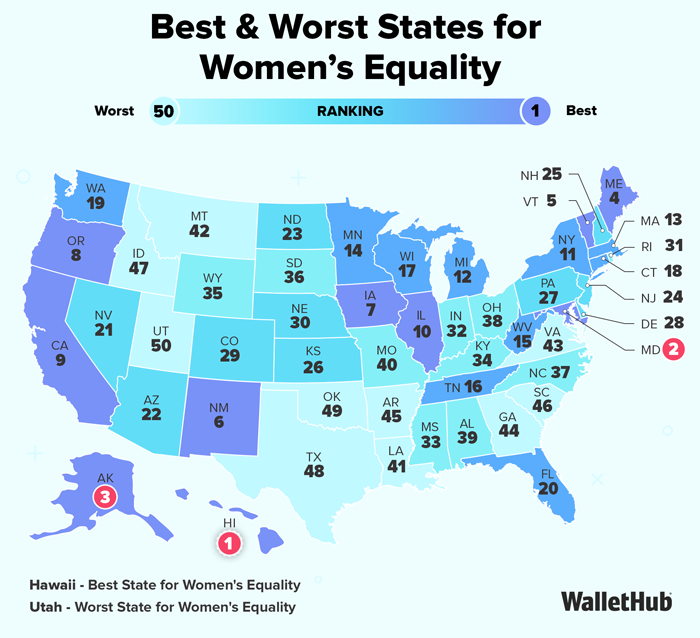
With Women’s Equality Day around the corner and the U.S. ranking just 43rd for gender equality worldwide, the personal-finance company WalletHub has released its report on the Best & Worst States for Women’s Equality in 2026, as well as expert commentary, to determine where women receive the most equal treatment in American society.
California did come in at number nine, breaking the top 10 best states in the survey. Women’s Equality Day will be observed on Aug. 26.
WalletHub compared the 50 states across 17 key metrics. The data set ranges from the gap between female and male executives to the disparity in unemployment rates for women and men to the income gap.
Best States for Women’s Equality
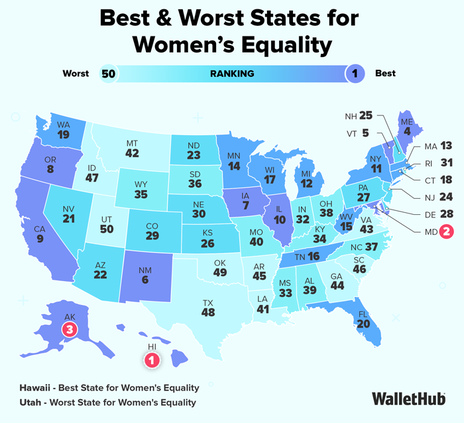
Ranked at the top, Hawaii was number one, the best state for women’s equality. It was followed by Maryland at number two, Alaska; Maine; Vermont; New Mexico; Iowa; Oregon; California; and at number 10, Illinois.
Worst States for Women’s Equality
Louisiana was at number 41, ranked in the bottom 10 states in terms of women’s equality. Next was Montana at 42, followed by Virginia; Georgia; Arkansas; South Carolina; Idaho; Texas; Oklahoma; and, last on the list, coming in at number 50 was Utah.
Best vs. Worst
In every state, women earn less than men. Maryland has the lowest gap, with women earning 1.40 percent less, whereas Utah has the highest, 26.90 percent.
In nearly every state, women represent the highest share of minimum-wage workers. Alaska, Hawaii and North Dakota have an equal ratio of women to men. Delaware and Georgia have the highest minimum-wage workers gap, at 70.00 percent.
Arkansas and New Mexico have the highest unemployment-rate gap favoring women, with 1.90 percent more unemployed men. Georgia and Maryland have the highest gap favoring men, with 0.70 percent more unemployed women. The unemployment rate is equal for men and women in Kansas, Texas and Utah.
In nearly every state legislature, male lawmakers outnumber their female counterparts. Nevada has the highest gap favoring women, with 62.50 percent more women. West Virginia has the highest gap favoring men, with 86.44 percent more men.
“Ensuring women’s equality requires more than simply giving men and women the same fundamental rights. States also need to work to make sure that women receive equal treatment to men when it comes to financial opportunities, education, and politics. The best states for women’s equality have drastically reduced the disparities between men and women on multiple fronts,” said WalletHub Analyst Chip Lupo. “Hawaii is the best state for women’s equality. There is no gap in the rate of men and women who are minimum-wage workers in Hawaii, and women are 1.3% less likely to be unemployed than men. On the education front, by eighth grade, there is only a slight math test score disparity between boys and girls. And when it comes to politics, Hawaii has no gender disparity among its national representatives.”
To view the full report and your state’s rank, visit:
https://wallethub.com/edu/best-and-worst-states-for-women-equality/5835
Expert Commentary
The U.S. currently ranks 58th globally when it comes to the gender gap in health and survival. What is driving this? What should be done to close this gap?
“I think it is important to keep in mind that the ranking reflects gaps in healthy life expectancy and the sex ratio at birth, so it is not a complete measure of women’s health care. That said, the U.S. has considerable and serious problems with unequal access, maternal mortality, reproductive health care, and racial bias in the practice of medicine. Black women, in particular, face much higher maternal mortality rates – in 2024, for example, it was three times that of white women. Closing the gap requires affordable coverage, stronger maternal and reproductive care, and better research and treatment that takes into account the differences among women.”
Marybeth Gasman – Distinguished Professor, Rutgers University - New Brunswick
“This ranking should be interpreted carefully because the World Economic Forum’s Health and Survival measure is relatively narrow, focusing on sex ratios at birth and differences in healthy life expectancy. It does not capture the full range of inequalities women experience in affordability, reproductive healthcare, maternal outcomes, insurance coverage, or geographic access. Nevertheless, the ranking points toward a broader problem: healthcare outcomes are shaped by fragmented and unequal systems of access. Coverage does not guarantee that an appropriate provider is nearby, accepting patients, affordable, or available when needed. More than one-third of U.S. counties are maternity-care deserts, and institutional closures shift travel, coordination, lost work, and financial risk onto women and families. These burdens fall especially heavily on rural women, lower-income women, and women of color. Closing the gap requires protecting reproductive and maternity-care access, strengthening the rural healthcare workforce, expanding insurance coverage, investing in preventive and mental healthcare, and addressing transportation and paid-leave barriers. Policymakers should evaluate healthcare access using measures such as distance, wait time, affordability, continuity, and outcomes – not simply whether a facility technically exists. The central question should be whether women can obtain appropriate care without assuming unreasonable financial, logistical, or personal risk.”
Emily C. Tanner, Ph.D. – Associate Professor of Marketing, John Chambers College of Business and Economics
What policies would prove effective at increasing female representation in senior management roles in the Fortune 500 and other large, multinational corporations?
“It is important for companies to have clear goals, public reporting, and accountability in hiring and promotion. They should track who receives promotions, leadership positions, and sponsorship … and hold senior executives responsible for the results. It is also essential to have transparent promotional standards and guidance, diverse candidate pools, paid family leave, affordable childcare, and flexible work policies. All too often, we ignore the extra weight that women carry in the family despite decades of evidence available to us.”
Marybeth Gasman – Distinguished Professor, Rutgers University - New Brunswick
“Effective policies should focus on the systems through which leaders are identified, evaluated, promoted, and retained. Organizations often invest in mentoring women while leaving subjective promotion criteria, unequal access to high-visibility assignments, and inconsistent sponsorship practices unchanged. Mentoring can be valuable, but it cannot compensate for an inequitable advancement system. Corporations should disclose workforce representation and compensation by organizational level, conduct recurring pay and promotion-equity audits, standardize promotion criteria, and review who receives revenue-generating assignments, international experience, developmental opportunities, and executive sponsorship. Leadership incentives should be tied to measurable progress rather than broad diversity commitments. Paid family leave, reliable childcare support, and meaningful workplace flexibility are also leadership policies. Women’s advancement often slows when caregiving responsibilities collide with rigid career structures. Flexible work must be accompanied by safeguards ensuring that employees who use it are not viewed as less committed or excluded from advancement. Finally, organizations must distinguish representation from inclusion. Appointing women to senior roles will not produce lasting change if their authority is constrained, their perspectives are discounted, or they face greater scrutiny and professional risk. Accountability is not simply the number of women occupying senior titles, but should include retention, promotion, decision-making authority, workplace climate, and employee well-being.”
Emily C. Tanner, Ph.D. – Associate Professor of Marketing, John Chambers College of Business and Economics
What are the most effective strategies for addressing the gender pay gap and promoting gender equality in the workplace?
“I think one of the best things that organizations and companies can do is be transparent about pay. It helps women and everyone if salary ranges (accurate and realistic ones) are published for potential candidates and current employees to see. Companies should also stop asking candidates for salary history, and this information hurts women who are typically underpaid. They should also conduct regular pay-equity audits and correct disparities. Women cannot challenge pay inequities if salaries are not transparent, and research shows that when transparency policies are in place, gender pay gaps are smaller. I also think broader policies also matter, including paid family leave, affordable childcare, predictable and regular scheduling, protections against discrimination and harassment, and better wages in occupations dominated by women.”
Marybeth Gasman – Distinguished Professor, Rutgers University - New Brunswick