With the cost of living having increased significantly over the past few years, proper budgeting is more essential now than ever. In light of this, the personal-finance company WalletHub has released its report on the States With the Best and Worst Budgeters in 2026, to show where Americans are being the most responsible with their finances and where they need to improve.
WalletHub compared the 50 states across 12 key metrics, ranging from the average credit score to debt-to-income ratios to foreclosure rates.
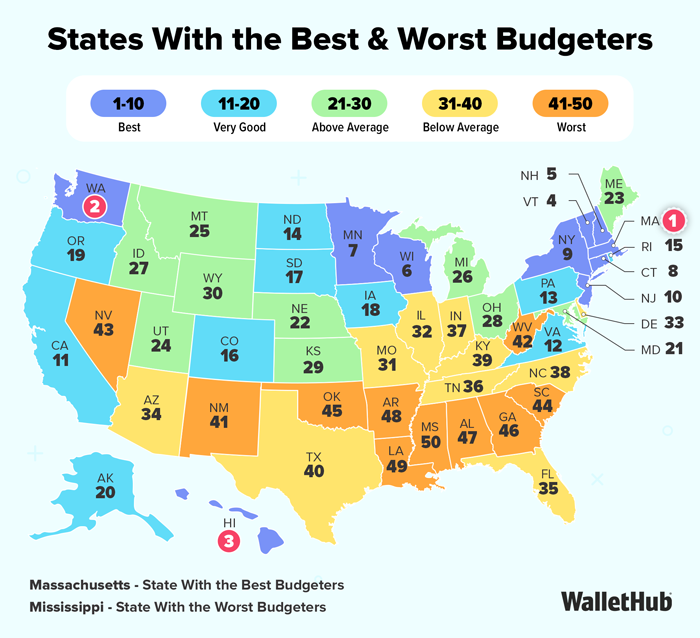
Massachusetts was number one overall, having the best budgeters, followed by Washington, Hawaii, Vermont and New Hampshire at number five. California was just outside the top 10, coming in at number 11.
States with the worst budgeters were Georgia at number 46, followed by Alabama, Arkansas, Louisiana and, at the bottom of the list, Mississippi at number 50.
Budgeters in California (1=Best; 25=Avg.)
Overall Rank: 11th
26th – Average Credit Score
9th – Non-Mortgage Debt as a Percentage of Income
2nd – Credit Utilization Percentage
2nd – Housing Expenses as a Percentage of Median Home Price
3rd – Percentage of Total Non-Housing Expenses to Median Income
“Not having a budget sets you up for financial failure. If you don’t carefully plan out and track how much of your income you can dedicate toward each of your expenses and other financial priorities each month, it’s easy for frivolous spending to get out of hand and prevent you from saving money, investing or even keeping up with your bills. Unfortunately, many people were never taught how to budget, so states should strongly consider requiring instruction on budgeting in schools,” said WalletHub Analyst Chip Lupo. “Massachusetts is the state with the best budgeters, and people in the state tend to take on relatively little debt compared to their income. For example, the state has the lowest median credit card debt and lowest car loan debt per person. Additionally, Massachusetts residents’ good budgeting skills are reflected in their high credit scores. Massachusetts has the sixth-highest median credit score in the country, at 741. That’s at the upper end of the good credit range, just 9 points below excellent credit.”
For the full report, visit:
https://wallethub.com/edu/states-with-the-best-worst-budgeters/138069
Expert Commentary
By Dr. Miren Ivankovic
Professor, Anderson University
Can budgeting help low-income families’ finances?
Yes, by all means. Many low-income families do not manage their budgets well. Usually, they do not manage their expenditures as well as they could. For example, groceries are purchased in stores where bulk purchases would be less expensive. On the other hand, income is spent too soon in some cases, and it does not cover paycheck to paycheck needs.
What is the most common mistake people make when it comes to managing their budgets?
They usually overspend. They purchase (consume) more than their income allows. Now, credit cards allow for this behavior, and as long as the credit card bills are met monthly (thus interest is not added to the principal), one is fine, but in many cases, that does not happen. Staying within one’s budget is a problem.
What tips do you have for consumers to get out of debt and stay debt free?
Well, debt is okay if managed properly. Most of us do have debt since we bought homes and cars, etc... Eventually, being debt free is okay, but managing the debt is even more important. If one has monthly car payments, then her income should cover that, which means less money is available for something else. Accumulating too much debt using credit cards is not wise at all, since interest rates on that kind of debt are in double digits.”
What is the best way for parents to teach their children how to budget?
Parents can play a large role in their children’s education about budgeting. Children can be given incentives to earn money and also to save it, for … future consumption. As they grow, parents can talk even more about budgeting, investments, savings and other personal finance topics. Hopefully, some of those are also covered in HS and College curriculums.