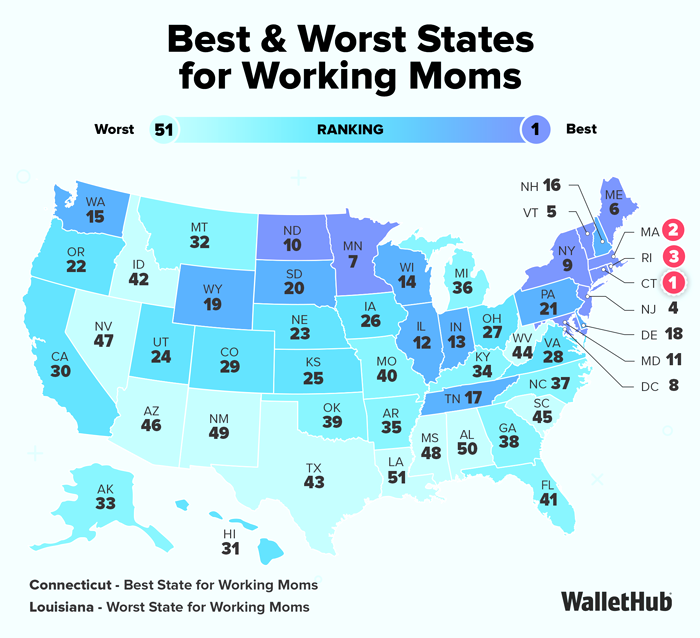
With Mother’s Day approaching and 74% of women with children under 18 participating in the labor force in 2025, the personal-finance company WalletHub has released its report on 2026’s Best & Worst States for Working Moms, as well as expert commentary.
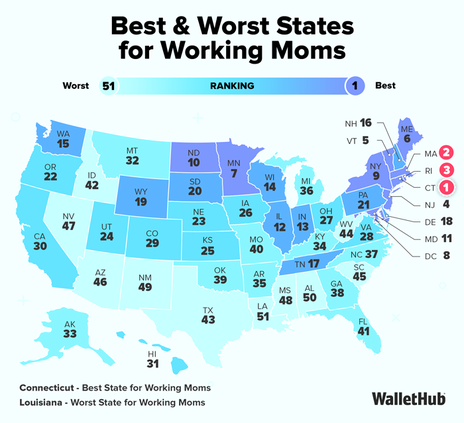
To highlight the states that offer the strongest support for mothers in the workforce, WalletHub analyzed all 50 states and the District of Columbia using 17 key metrics. The data set includes factors such as women’s median salaries, female unemployment rates, and the quality of day-care options. Connecticut was ranked at number one in the report while California came in at number 30. Rated as the worst state for working moms was Louisiana, according to the study results.
Life as a Working Mom in California (1=Best; 25=Avg.):
Overall Rank: 30th
37th – Day-Care Quality
48th – Child-Care Costs (Adjusted for Median Women’s Salary)
13th – Pediatricians per Capita
5th – Gender Pay Gap (Women’s Earnings as % of Men’s)
33rd – Ratio of Female Executives to Male Executives
48th – Median Women’s Salary (Adjusted for Cost of Living)
48th – Female Unemployment Rate
6th – Parental-Leave Policy Score
16th – Avg. Length of Woman’s Work Week (in Hours)
15th – % of Single-Mom Families in Poverty
“The U.S. still has a lot of work to do when it comes to improving conditions for working moms, given the wage gap and the lack of representation women have in certain leadership positions. However, some states are significantly better than others. The best states for working moms provide equitable pay for women and a strong potential for career advancement, along with robust parental leave policies and high-quality child care, health care, and schools,” WalletHub Analyst Chip Lupo said. “Connecticut ranks as the best state for working moms, and it had some of the lowest unemployment rates for women last year, at just 2.7%. It also has a small gender pay gap, with women earning over 89% of what men make, the fourth-highest rate in the country highlighting the state’s commitment to pay equity and economic opportunities for women. Finally, Connecticut has very good parental-leave policies and is among the best places in the country for working from home.”
For the full report, visit: https://wallethub.com/edu/best-states-for-working-moms/3565
Expert Commentary
What can companies do to help working parents balance their home and work life?
“Companies can provide working parents with pay that is high enough to cover child care costs, while also providing as much flexibility as possible, especially for family medical leave.”
Rachel Wu, Ph.D. – Associate Professor, University of California, Riverside
“Affordable child care is key for working parents. Companies that provide or support child care are an enormous aid for working parents. Flexibility in work hours and remote work options, at least on some days, also assist working parents in dealing with child care, medical appointments, and school events.”
Ann C. Hodges – Professor Emerita, University of Richmond
What careers are the most difficult and the easiest for balancing work and family?
“Any job that requires very strict schedules, especially ones that interfere with daycare/school drop-off and pick-up times, as well as requiring a lot of travel will put a strain on parents, especially moms.”
Rachel Wu, Ph.D. – Associate Professor, University of California, Riverside
“Careers that provide flexibility for working parents are the easiest for balancing work and family. That flexibility may come with the career itself or … with a career that offers a variety of work options, some with flexibility. Nursing, for example, offers a variety of job options, some which provide flexibility and some which do not. In particular careers, the employer will make the difference, as some employers will provide the needed flexibility while others may not. In other careers, regardless of employer, the career option offers little flexibility. Jobs that require physical presence on the job site for specific hours, particularly for hours when children are unlikely to be in school or day care, are the most difficult to manage. Careers with evening or weekend work hours, however, may enable one parent to work those hours while another works standard work hours, minimizing the need for child care.”
Ann C. Hodges – Professor Emerita, University of Richmond
What steps should policymakers take to support working mothers’ labor force participation and address disparities between men and women in the labor market?
“Universal/heavily subsidized daycare (similar to the German model), guaranteed and highly flexible maternity and paternity leave, more childcare/fertility incentives/benefits.”
Rachel Wu, Ph.D. – Associate Professor, University of California, Riverside
“In recent years some states, in addition to requiring equal pay for equal work based on gender, have enacted other laws designed to encourage gender equity. Two examples are pay transparency laws, which require job ads or postings to specify the pay or pay range, and laws prohibiting prospective employers from asking about prior salary. Enacting such laws where they don’t exist, and providing robust public enforcement of all laws requiring or supporting pay equity, would support working mothers and reduce pay disparities. Similarly, paid leave laws should be enacted for both parents after birth and for illness of the employee or a family member. Only a small number of states have such laws at present. Finally, subsidies and/or tax credits for child care will also be of significant benefit to working parents.”
Ann C. Hodges – Professor Emerita, University of Richmond