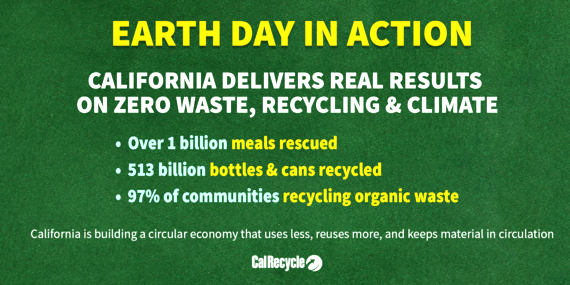
With multiple efforts across the state during the recent observance of Earth Day, officials noted that California is proving that cutting waste and protecting communities can go hand in hand. New statewide data shows California’s shift toward a circular economy, one that uses less and reuses more, is delivering real results for people, businesses, and the environment.
Organics Recycling and Food Recovery
1.08 billion meals rescued and delivered to Californians facing hunger under the state’s organics recycling and surplus food rescue law.
97% of required communities and 75% of required businesses now have the capacity to recycle organic waste, turning food into energy and compost instead of methane.
3 million cars’ worth of air pollution will be cut each year by achieving California’s food recycling and rescue goals.
Beverage Container Recycling
513 billion beverage containers collected for recycling under the state’s deposit-return system, including a record 20 billion in 2024.
Over 1,300 CRV redemption sites available, with more sites opening soon.
$80 million in funding now available for new recycling sites.
70% recycling rate for California Redemption Value (CRV) containers.
Electronic Waste
2.7 billion pounds of E-waste collected and safely managed under California’s Covered Electronic Waste Recycling Program.
Largest E-waste recycling program expansion launched in 2026, adding battery-embedded products to increase recycling and prevent battery fires.
Producer Responsibility Success
California’s nation-leading extended producer responsibility (EPR) laws are shifting the burden of collection and proper management from consumers to industry. To date, these programs have collected and responsibly managed:
12.7 million mattresses;
39 million gallons of paint;
1.3 billion pounds of carpet;
2.4 million pounds of pharmaceutical waste;
1.3 million pounds of home-generated sharps waste.
What’s Next
California will soon see new producer funded and managed programs, including:
Responsible Textile Recovery Act (SB 707, 2024) creates an industry-funded and managed system to collect, repair, reuse, and recycle textiles and apparel.
Loose battery EPR (AB 2440, 2022) makes producers responsible for collection and recycling of covered batteries, with drop-off sites in every county, including at major retailers.
Packaging Producer Responsibility (SB 54, 2022) requires producers to design more sustainable packaging and finance statewide systems to collect, recycle, and reduce single-use plastic waste.
By 2032:
100% of single-use packaging and plastic food service ware sold in the state will be recyclable or compostable;
65% of single-use plastic packaging and food service ware will be recycled;
25% less plastic will be sold statewide.
Building California’s Circular Economy and Waste-Free Future
California’s Zero Waste Plan is more than an environmental strategy; it is also an economic one. A fully circular economy in the state by 2050 is projected to generate:
$411 billion in economic growth;
$11 billion in avoided health and environmental costs;
Over 500,000 new jobs across recycling, reuse, and manufacturing sectors.