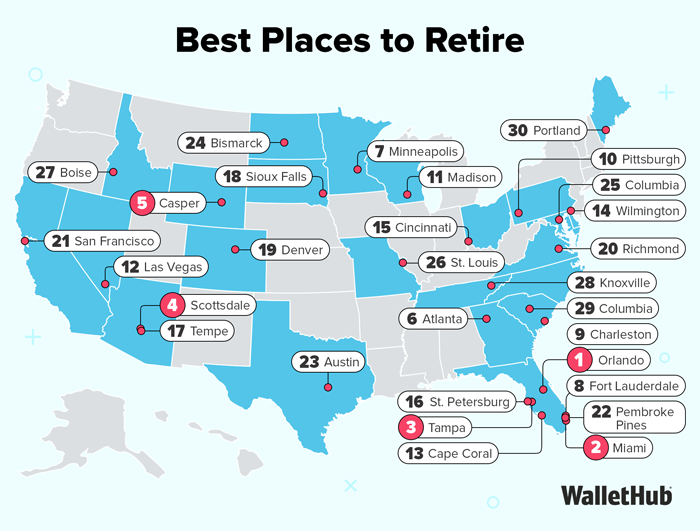
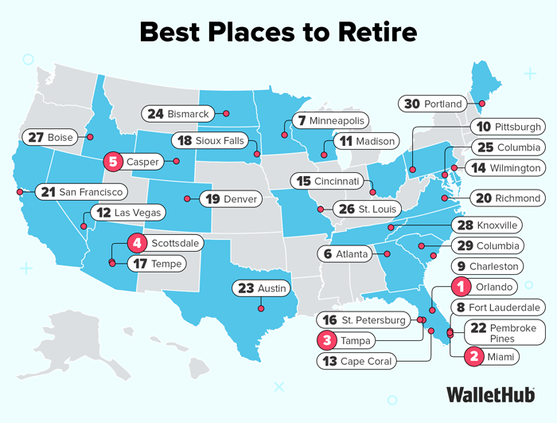
With inflated prices making retiring on a fixed income more difficult, the personal-finance company WalletHub recently released its report on the Best & Worst Places to Retire in 2026, to help people find an ideal spot to enjoy their golden years without breaking the bank.
WalletHub compared more than 180 U.S. cities across 45 key measures of affordability, quality of life, health care and recreational activities.
Best Cities to Retire
Orlando, Florida was ranked as the best city in which to retire, followed by Miami, FL; Tampa, FL; Scottsdale, AZ; Casper, WY: Atlanta, GA; Minneapolis, MN: Fort Lauderdale, FL; Charleston, SC; and rounding out the top 10, Pittsburgh, PA.
Worst Cities to Retire
Ranked at 173, leading off the bottom 10 cities for retirees, was Fontana, California. It was followed by Detroit, MI; Bridgeport, CT; Tacoma, WA; Bakersfield, CA; Rancho Cucamonga, CA; Fresno, CA; Newark, NJ; San Bernardino, CA; and at 182, the worst city for retirees, was Stockton, CA.
“It’s important to choose wisely when picking where to retire, as many retirees are on a fixed income. As a result, the best cities for retired people are those that minimize taxes and expenses, as well as have good opportunities for retirees to continue paid work for extra income, if they choose to do so. In addition, the top cities provide high-quality health care and offer plenty of enjoyable activities for retirees,” explained WalletHub Analyst Chip Lupo. “Orlando, Florida, is the best place to retire, in part because it is one of the most tax-friendly cities and is located in a state without estate, inheritance or income taxes. In addition, while Orlando doesn’t have a particularly low cost of living, it is relatively inexpensive when it comes to homemaker services and adult day health care. On top of that, Orlando ranks as the second-best city for recreation, and it provides good access to quality health care.”
To view the full report, visit: https://wallethub.com/edu/best-places-to-retire/6165
Retirement Savings Survey
Pension preference. 7 in 10 people believe a pension is better than a 401(k).
Americans worry about retirement. More than 1 in 3 Americans are not confident they will have enough money to retire.
Benefit trade-off. More than half of Americans say they would prefer to pay a 12.4% Social Security tax to get double the benefits rather than a 6.2% tax and current benefits.
Retirement doubt. 43% of people believe it is not realistic for the average American to expect to retire comfortably.
Many people may never retire. 40% of people say they expect to work until they die.
Debt takes precedence. More than 2 in 5 Americans think paying off debt is more important than making retirement contributions.
For the full survey, visit: https://wallethub.com/blog/retirement-savings-survey/133047/
Expert Commentary
Kenneth S. Shultz Ph.D.
Department Chair of Psychology,
California State University, San Bernardino
What financial factors should retirees take into consideration when deciding where to retire?
There are a wide range of financial factors that need to be considered when someone is deciding where to spend their retirement. For example, tax burdens in various states can vary widely. While some states such as Florida and Texas may not have state income taxes, their property and sales taxes tend to be higher. Early in retirement, most couples look forward to expensive vacations (e.g., ocean cruises, international travel), that would require ready sources of cash, that may not be available if you just put a large downpayment on a new home for retirement. In addition, adult children and grandchildren, as well as aging parents, often need more personal and financial assistance than in the past. As a result, you may need to consider these demands when deciding where you are going to live during your retirement years.
What tips do you have for living on a fixed income during retirement?
Traditionally, financing retirement was thought of as the three-legged stool – consisting of guaranteed pensions, social security, and personal savings. However, fewer employers are offering their employees guaranteed pension benefits (AKA, defined benefit pension plans). These have been replaced with 401k, 403b, and 457 plans (AKA, defined contribution retirement plans), where a steady stream of income and returns is not guaranteed. In addition, the employee must assume the risk of managing their retirement accounts. If one is too aggressive in investing their retirement funds, they may lose a significant portion of their accounts with a market downturn. However, if they are too conservative in their investing, they may not keep up with inflation and struggle to cover their living expenses in retirement over time. Thus, it is important to plan for a mixture of accounts that help provide a hedge against inflation, while also being able to weather market downturns. An increasingly popular option for retirees is to convert a portion of your 401k or IRA plan into a guaranteed, lifetime annuity. That way you will have a source of some guaranteed income in retirement, while still having some flexibility with the remaining funds.
What is the biggest mistake that people make when planning their retirements?
Most literature on retirement focuses on the financial aspects of retirement, which are of course important. However, much less literature is available on the psychological aspects of retirement. The preparation and thought that needs to go in to not just “retiring from” a job or career, but what do you want to “retire to” in retirement. This is particularly important for individuals who are part of a couple, where one person in the relationship may have one set of expectations for retirement (e.g., world travel), while the other has a very different set of expectations (e.g., staying closer to home to engage in long neglected hobbies).
Nearly half of American households have no retirement savings. What consequences will this cause in the future?
As noted above, pensions are disappearing and social security currently has a lot of uncertainty around it, so the fact that nearly half of all American households have no retirement savings is very alarming. The long-term downward trend in old age poverty rates may well end up reversing with most households having inadequate retirement savings. The adage that the best time to plant a tree was 20 years ago and the second-best time to plant a tree is today, holds for retirement savings. While ideally most individuals approaching retirement contributed regularly to their retirement accounts starting 20+ years ago, thus taking advantage of long-term compound earnings, but if not, you can start saving today knowing you may well spend several decades in retirement.