With Oct. 1 being World Vegetarian Day, Nov. 1 being World Vegan Day, and meat prices getting hit much harder by inflation than fruit and vegetable prices, the personal-finance company WalletHub has released its report on 2026’s Best Cities for Vegans & Vegetarians, as well as expert commentary, to identify the places that make a switch to a plant-based diet easiest.
California placed four cities in the top 20 list.
To determine the best and cheapest places for a plant-based diet, WalletHub compared the 100 largest cities across 17 key indicators of vegan- and vegetarian-friendliness. The data set ranges from the share of restaurants serving meatless options to the cost of groceries for vegetarians to the number of salad shops per capita.
Top 20 Cities for Vegans & Vegetarians
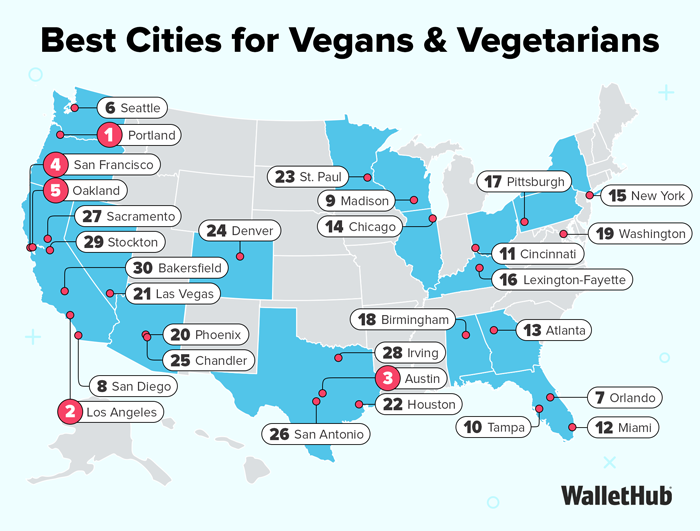
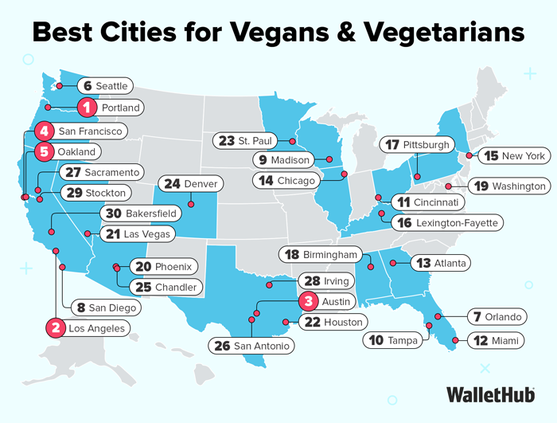
Portland, Oregon was named as the top city in the country for vegans and vegetarians, followed by Los Angeles, CA; Austin, TX; San Francisco, CA; Oakland, CA; Seattle, WA; Orlando, FL; San Diego, CA; Madison, WI; and, rounding out the top 10, Tampa, Florida.
Ranked 11 through 20 were Cincinnati, Ohio; Miami, FL; Atlanta GA; Chicago IL; New York, NY; Lexington-Fayette, KY; Pittsburgh, PA; Birmingham, AL; Washington, DC; and at number 20, Phoenix, Arizona.
Best vs. Worst
Scottsdale, Arizona, has the highest share of restaurants serving vegetarian options, which is 12.4 times higher than in Laredo, Texas, the city with the lowest.
Scottsdale, Arizona, has the highest share of restaurants serving vegan options, which is 59.7 times higher than in North Las Vegas, Nevada, the city with the lowest.
San Francisco has the most community-supported agriculture programs (per square root of population), which is 26.8 times more than in Houston, Texas, the city with the fewest.
Atlanta, Georgia has the most salad shops (per square root of population), which is 17.15 times more than in Santa Ana, California, the city with the fewest.
“While vegetarians and vegans are still a relatively small share of the population, businesses are recognizing their impact on their market. Just look at businesses like McDonald’s and Burger King incorporating Beyond Meat and Impossible burgers into their menus, for example. With meat prices rising significantly faster than vegetable prices, too, we may see a lot more people taking a foray into a vegetarian or vegan lifestyle in the near future,” WalletHub Analyst Chip Lupo said. “Portland is the best city for vegans and vegetarians in 2026, and its residents eat this type of food 148% more often than the U.S. average. In addition, the city also has the fourth-highest number of affordable restaurants with vegan and vegetarian options that have at least 4.5 stars on Yelp. Portland also has the ninth-most farmers markets, second-most organic farms, fourth-most community gardens and fourth-most vegetable nurseries and gardening shops per capita.”
To view the full report, visit:
https://wallethub.com/edu/best-cities-for-vegans-vegetarians/39706/
Expert Commentary
By Marybeth Gasman,
Rutgers University
What tips do you have for a person who wants to become a vegetarian? How can they make the transition smoother?
For most people, a gradual transition works best. I’d begin with a few meatless meals each week, then move to more as you get used to it. If you have enough variety, you won’t miss meat for long. The trick is having a variety of tastes and textures. Spices are your best friend. I would avoid meat substitutes, as they typically don’t taste great and you’re more likely to go back to eating meat. As a vegetarian, I don’t want to taste things that are supposed to taste like meat because I don’t want to eat meat. The best advice I can give is to focus on what you are adding to your new vegetarian diet rather than what you are taking away.
Should the government subsidize the purchase of fruits and vegetables by discounting the price for people using food stamps?
Absolutely! It is really important that everyone has access to fruits and vegetables, as they are the foundation of better health. SNAP should also include fresh, frozen, and canned fruits and vegetables without added sugar and excessive sodium.
What are the most common mistakes people make when being on a vegan or vegetarian diet, and how can they avoid them?
I think the biggest mistake is relying heavily on processed foods. It’s much better to eat fresh vegetables and whole grains. You also have to make sure to eat enough protein, but you can get plenty as a vegetarian. I typically get about 75-90 grams of protein a day from vegetables, beans, dairy products, and eggs. It can be harder as a vegan, but you can add pea protein to your morning smoothie to help you meet your protein goals. Some vegetarians (especially vegans) miss out on nutrients such as iron, calcium, vitamin B12, vitamin D, iodine, and omega-3 fats. However, there are supplements that can help address these deficiencies. Another mistake is eating too many carbohydrates. It is easy to replace meat with carbs, and you want to avoid doing so, as it can lead to significant weight gain.