With “exercising more” and “being happy” among the top New Year’s resolutions for 2026, the personal-finance company WalletHub released its report on 2026’s Best & Worst Cities for an Active Lifestyle.
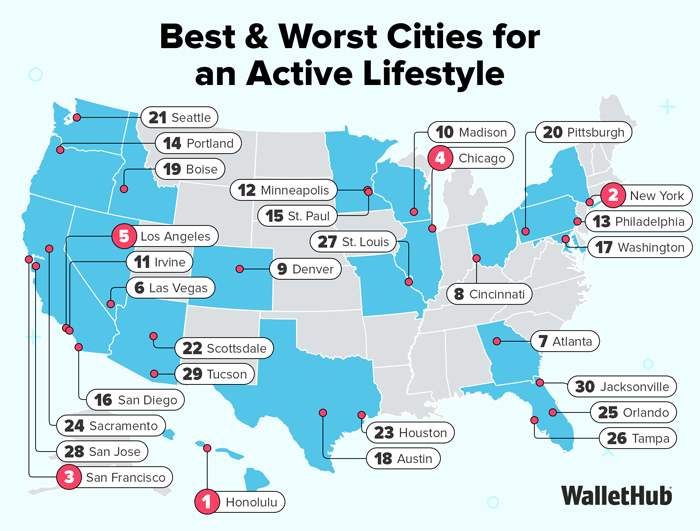
San Francisco and Los Angeles were in the top five ‘best’ cities list.
To determine where Americans have the best chance of remaining active, WalletHub compared the 100 biggest U.S. cities across 35 key metrics. The data set ranges from the average monthly fitness-club fee to the city’s bike score to the share of physically inactive adults.
Best Cities for an Active Lifestyle
Honolulu, Hawaii was rated as the best city for an active lifestyle, taking the number one spot. Next was New York, NY, followed by San Francisco, CA; Chicago, IL; Los Angeles, CA; Las Vegas, NV; Atlanta, GA; Cincinnati, OH; Denver, CO; and, rounding out the top 10, Madison, Wisconsin.
Worst Cities for an Active Lifestyle
Coming in at number 91 was North Las Vegas, Nevada, with the rest of the bottom 10 including Winston-Salem, NC; Newark, NJ; Corpus Christi, TX; Hialeah, FL; San Bernardino, CA; Fresno, CA; Fort Wayne, IN; Irving, TX; and at number 100, the worst city in the study for an active lifestyle, Garland, Texas.
Best vs. Worst
Orlando, Florida, has the most sporting-goods stores per capita, 8.7 times more than in Newark, New Jersey, which has the fewest.
Scottsdale, Arizona, has the most public golf courses per capita, 39.1 times more than in Laredo, Texas, which has the fewest.
Denver and Aurora, Colorado, have the most fitness trainers and aerobics instructors per capita, 7.2 times more than in Corpus Christi, Texas, which has the fewest.
Las Vegas has the most playgrounds per capita, 24.4 times more than in Gilbert, Arizona, which has the fewest.
To view the full report, visit:
https://wallethub.com/edu/best-and-worst-cities-for-an-active-lifestyle/8817
“The top cities for staying active offer opportunities for all types of people, from those who prefer team sports to people who simply want to get their daily exercise by walking or biking to work. They also tend to be large cities that still have a close proximity to beautiful natural areas for hiking and swimming. Finally, the top cities for an active lifestyle have populations that are highly interested in exercise, which helps people find workout partners and stay motivated,” WalletHub Analyst Chip Lupo said. “Honolulu is the best city for an active lifestyle, in large part because it promotes community sports more than any other city, with an extremely high number of baseball fields, skate parks, volleyball courts and tennis courts per capita. Even if you’re not interested in team sports, the city’s proximity to the ocean allows for easy access to swimming and surfing, and it’s the top city for hiking trails as well. Plus, it has the third-most acres of parkland per capita. Honolulu ranks third in the nation for air quality, too, so that will help your breathing while you engage in outdoor activities.”
Expert Commentary
How can local communities encourage and facilitate active lifestyles among residents?
“I think one of the best ways to encourage active lifestyles is to have the infrastructure in place that is provided by your community. For example, having bike paths, sidewalks, parks, and open space that encourages walking, hiking, biking, and outdoor activities. In my travels I’ve been to some places in the United States that have these features in place and there are people utilizing them because they feel safe riding a bike on a bike path vs. the road, or walking on a sidewalk or path vs. the side of a street. When communities put in a public park they see people walking their dogs there or jogging. In contrast I’ve been to other places where there are no sidewalks by the streets or bike paths. So even for a short trip of a quarter or half mile, people drive their car because there is simply no place to walk to their destination. The same applies to recreational biking or e-biking, it’s more dangerous to ride on the road and many people are not comfortable doing so.”
Thunder Jalili, Ph.D. – Professor, The University of Utah
“Local communities can encourage and facilitate active lifestyles among residents in at least three ways: Establish friendship and support systems and initiatives that encourage persons to do things together. For example, have Monday, Wednesday, Friday, Saturday 8 a.m. and Tuesday, Thursday, Sunday 6 p.m. walking groups. Make walking a leisurely activity that promotes conversation and community. Develop age-appropriate outdoor games for the children in the neighborhood, such as jump rope, hopscotch, ball practice, etc. Have parents or caregivers take part in supervising the activities, perhaps even playing too. Advocate for neighborhood parks or play areas. Work with neighbors and local leaders to designate and design open areas as parks that are ‘owned’ by that community.”
Judith Rodriguez, PhD, RD/N – Professor Emeritus, University of North Florida
What tips do you have for someone looking to maintain an active lifestyle on a budget?
“There are many ways people can be physically active without breaking the bank. Walking in and around your neighborhood or developing a ‘walking club’ with neighbors is an easy way to increase movement without having to spend a lot of money. If a family is involved, engaging in family sports in a park or nearby greenspace is a great way to increase physical activity as are activities at home such as turning on your favorite music and having a ‘dance party.”
Dena Herman, PhD, MPH, RD – Professor, California State University, Northridge; Director, MCH Nutrition Leadership Training Program, UCLA Fielding
“Being active does not require a big budget. One of the best forms of exercise is simply walking. If you’re looking for a greater burn without additional financial investment, increase speed, or find some hills. There are many great options for free strength training or stretching videos on YouTube. If you don’t have weights available, body weight exercises such as squats and push-ups, are an excellent option. Additionally, I also always encourage clients to be inefficient with movement. Rather than trying to carry everything up the stairs in one trip, carry items individual and go up and down six times. These small but more intentional movements add up!”
Dara W. Ford, PhD, RDN, LDN – Professorial Lecturer, American University
How can parents encourage children to be active in order to combat obesity?
“Active parents are more likely to have active kids. So, it is important for parents to model physical activity. Furthermore, experimental research from our group suggests that parents engaging in physical activity with children significantly increased the physical activity of the child vs. a parent just watching. In other words, if you take your child to the park, put away your phone and play along with them. It will benefit you as well.”
Jacob E. Barkley, PhD – Professor, Kent State University
“Parents can play an important role by modeling active behaviors, such as choosing stairs over elevators when it is safe to do so and making time for regular exercise. It is helpful to teach children that movement is a privilege, not a chore, and that we exercise to feel well, have energy, and stay strong, rather than simply to lose weight or burn calories. Parents can also limit screen time and create opportunities for enjoyable physical activity through family walks or bike rides, dancing together, playing active games like tag or frisbee, or gardening as a family. Introducing structured routines early and using positive reinforcement can make these habits stick, helping children build a foundation for lifelong health.”
Dr. Casey Colin, DCN, RDN, LDN, FAND – Associate Professor, University of North Florida