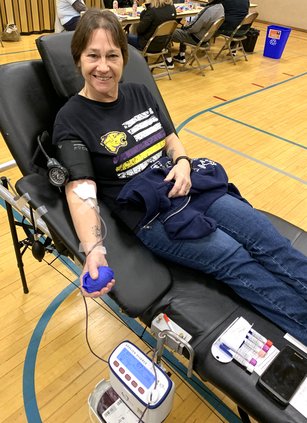
Marg Jackson is among an elite three percent.
While, roughly 62 percent of the American population is eligible to donate blood, the Red Cross reports roughly only 3 percent actually do.
Fortunately, most donors, like Jackson are committed to donate routinely.
As a longtime blood donor, the local resident and editor of The Oakdale Leader, Riverbank News and Escalon Times, is hard pressed to share exactly how long she’s been a donor.
“I actually gave blood in New York,” Jackson said of where it all began. “So that pre-dates the 99 here. I gave a little bit in New York and then there was kind of a lengthy gap between donating there and donating here.”
The ‘99’ refers to Jackson’s total donations since moving to California. A number she took to 100 last month as the Red Cross celebrated National Blood Donor Month.
“Originally when I worked at the radio station in New York, they were co-hosting a drive and the office manager asked, have you ever given blood?” the editor said of how it all began. “I said no and she said, well come with me. I said why? She said because it doesn’t hurt and it does good.”
The rest, as they say is history. For well over a decade, Jackson has made being a donor just something she does, routinely.
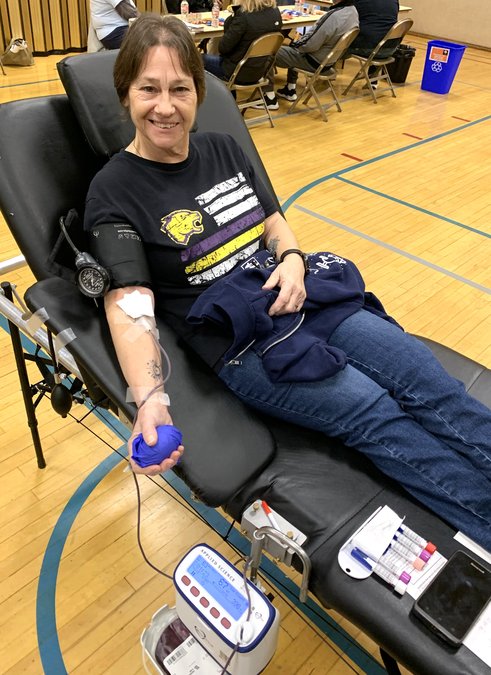
Classified as a fast bleeder, Jackson shared she’s typically on the table five to six minutes.
“Once I get on the table, I’m very fast,” she shared. “What takes longer is doing the intake stuff but you can do that online now.”
Donors can give whole blood up to six times a year and each donation can help up to three people in need.
After the taking of vitals and confirming answers on the questionnaire, the donation is made, along with collecting several small vials of blood for testing to make sure the blood is suitable for donation. Donors are also required to stay for a 15-minute rest and refreshment break prior to leaving the donation site.
“I like the fact that my blood type is B Positive,” Jackson chuckled as she shares. “I like that.”
Fortunately, Jackson nor an immediate family member have ever been a recipient or found themselves in a place of needing blood. Yet Jackson shared there is a newer feature available to donors that can help them track where their donation went, whether in California or elsewhere.
“I’m sure some people have had bad experiences, but I find it oddly enough relaxing,” Jackson added of the donation process. “It’s just a good feeling of community.”
Now, as a 100-unit donor, Jackson is far from done doing her part to stay among the three percent. Not only is she committed, she encourages others to do it as well.
“Your blood replenishes itself. You might be a little tired for a few hours after, but the amount of the recovery time that you need is so small and the fact that you know you’re helping people and can do it on a regular basis, that’s worth it,” she said. “It’s just about being able to do something that is so small for me to do, but can be significant for someone else.”